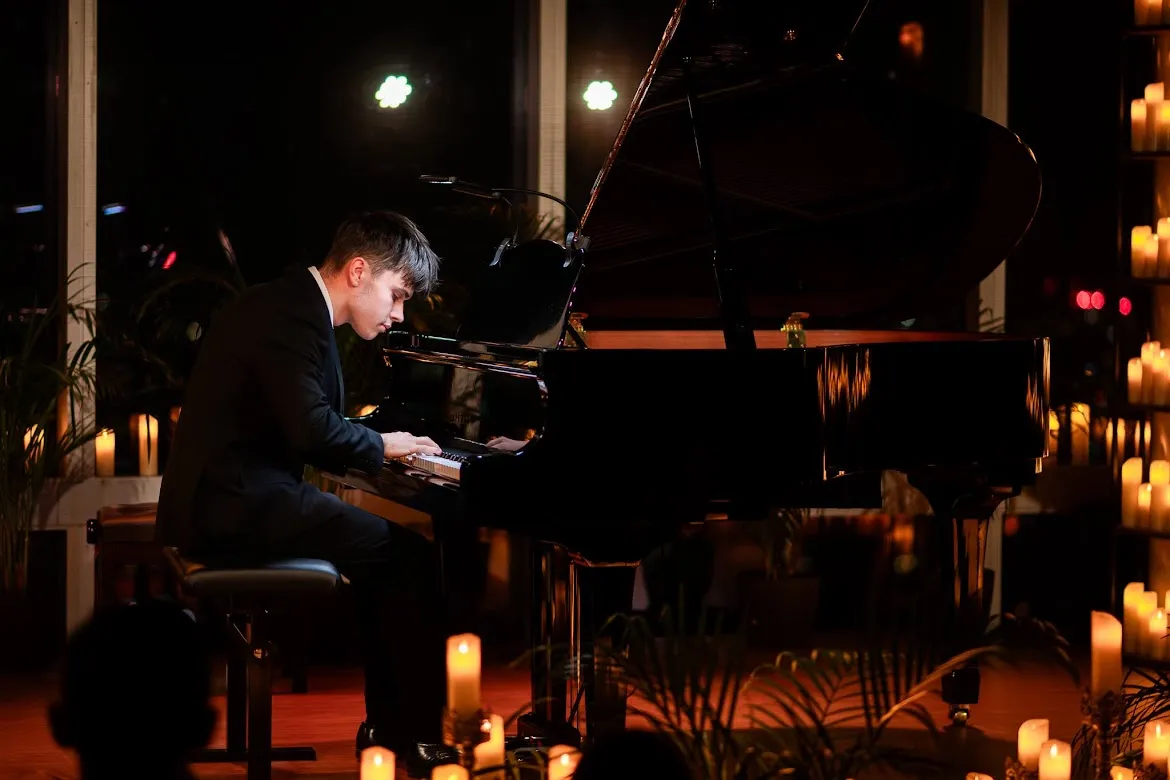
A FortepianArt pianist performing on a grand piano at a candlelit concert

Trinity College London · Registered Exam Centre No. 76372

From the first lesson
to the international stage.

Piano, vocal, guitar, drums and performance education for children, teenagers and adults — with individual lessons, Trinity examination preparation, stage training and international music projects.

Warsaw • Poland • Online • International

LearnPreparePerformProgress internationally

Why choose FortepianArt?

More than music lessons — a journey towards confidence, creativity and achievement.

The right teacher can do much more than teach an instrument. Music education can inspire confidence, nurture creativity, develop discipline and open the door to a lifelong passion for music. Our teachers are musicians and educators who understand that every student is unique — with their own abilities, ambitions and pace of learning.

01

Inspire

We help students develop creativity, musical expression, confidence, individuality and performance skills — and give them real opportunities to perform for an audience, turning ability into genuine stage presence.
02

Motivate

Your music. Your goals. We listen to what students want to learn and the music they love. Favourite songs and styles become part of the lesson, with clear, achievable goals and progress you can see and celebrate.

03

Learn

Music education for every age and level — from personal development and enjoyment to performance, academic goals and internationally recognised Trinity College London qualifications.

A family approach to music education

Music brings people together. We encourage a supportive environment where parents and children can share the experience of learning, practising and enjoying music — students of different ages and abilities learning within the same inspiring musical community.

At FortepianArt, we don’t just teach music — we develop musicians.

Music education

Choose your instrument

Individual lessons, online and in person, adapted to each student’s goals, interests, experience and pace of learning.

Piano

Classical piano · Contemporary repertoire · Musical interpretation · Trinity preparation

Vocal

Vocal development · Musical expression · Performance · Stage confidence

Guitar

Classical guitar · Acoustic guitar · Contemporary music · Performance

Drums & Percussion

Rhythm and groove · Technique and coordination · Reading · Band performance

Performance

Concert preparation · Stage presence · Performance skills · Confidence

For

  • Children
  • Teenagers
  • Adults

Levels

  • Beginners
  • Intermediate
  • Advanced

Format

  • In person, Warsaw
  • Online

Trinity College London

Registered Exam Centre No. 76372 in Warsaw

FortepianArt provides a professional environment for candidates taking Trinity College London Music examinations — from Initial to Grade 8, with a pathway to advanced Music Performance Diplomas.
Trinity College London Rock & Pop — Registered Exam Centre 76372

Your Trinity pathway

Exam preparation

  • Repertoire selection
  • Technical development
  • Musical interpretation
  • Performance practice
  • Examination requirements
  • Effective home practice
  • Mock examinations
  • Performance confidence

At our exam centre

  • Student registration for exams
  • Exam dates, requirements and payment
  • Exam guidance and support
  • Initial – Grade 8 and Music Performance Diplomas

Books & materials

  • Trinity books for each grade
  • Examination materials
  • Preparation resources
  • Help with ordering Trinity books and materials
Ask about materials →

Prepare with confidence. Perform with expression. Progress internationally.

Everything about Trinity exams at FortepianArt → Fees & packages →

Community

For students and teachers

For students

  • Individual music education
  • Trinity exam preparation
  • Concerts and performances
  • Competitions
  • Masterclasses
  • International music projects
  • Certificates and recognised qualifications
Enrol as a student

For teachers

  • Trinity examination information
  • Teaching and preparation resources
  • Lectures and professional meetings
  • Masterclasses
  • International collaboration
  • Opportunities to work with FortepianArt
Collaborate with us

Our teachers — professional musicians, experienced educators

Candlelit concert performance

Performance, events & international projects

From the lesson room to the stage

Music is meant to be performed. Through concerts, stage projects and musical events, students learn to prepare, perform, communicate, manage stage confidence and express music — moving from practising alone to performing with confidence.

We develop international musical and educational projects connecting students, teachers and musicians worldwide — online and in person.

  • Concerts
  • Competitions
  • Masterclasses
  • Lectures
  • Music academies
  • International projects
  • Lectures with musicians from around the world

News & student achievements on Instagram →

Maryna Rak on stage beside a grand piano at a candlelit concert

Founder & Director

Maryna Rak

Founder and Director of FortepianArt – International Music Hub · Piano teacher · Representative of Trinity College London Registered Exam Centre No. 76372, Warsaw

Maryna Rak is a professional musician, piano and organ teacher, accompanist, and music education specialist with more than 21 years of professional experience in music education, performance, student development, and the management of educational institutions.

Her professional education includes the Fryderyk Chopin University of Music in Warsaw, where she earned a master’s degree and qualified as a chamber ensemble artist and accompanist, as well as a piano and organ teacher. She also graduated from the I. P. Kotlyarevsky Kharkiv National University of Arts, qualifying as a chamber ensemble artist, accompanist, and piano and organ teacher. In addition, she holds a master’s degree in higher education pedagogy.

Maryna has extensive experience in music education, student development, concert performance preparation, and the management of music schools. Throughout her professional career, she has worked as a piano and vocal teacher, accompanist, higher education lecturer, school director, and educational administrator. She is a member of the European Piano Teachers Association (EPTA) and actively participates in the international professional music education community.

Today, Maryna leads FortepianArt – International Music Hub, providing high-quality international music education to children, teenagers, and adults in Warsaw and online. Her mission is to combine professional music education, individual development, and international opportunities, helping every student become a confident, creative, and goal-oriented musician.

EPTA — European Piano Teachers Association
Member of the European Piano Teachers Association (EPTA)

EPTA is an international professional organisation dedicated to promoting excellence in piano teaching, supporting music educators, and encouraging professional development and international cooperation in piano education.

Admissions & recruitment

Student enrolment is ongoing

New student registration · Teacher recruitment and collaboration · Individual consultation · Online and face-to-face lessons

Start your musical journey

FAQ

Frequently asked questions

Who can study at FortepianArt?

We welcome children, teenagers and adults of different ages and musical levels.

Do I need previous musical experience?

No. Beginners are welcome. We also work with students who already have musical experience and want to develop further.

Do you prepare students for Trinity examinations?

Yes. FortepianArt provides preparation for Trinity College London Music examinations, from Initial to Grade 8, with pathways towards advanced Music Performance Diplomas.

Where are the lessons held?

Lessons are held at Pastewna 25 in Warsaw and, where appropriate, online.

Is FortepianArt a Trinity exam centre?

Yes. FortepianArt is a Trinity College London Registered Exam Centre No. 76372 in Warsaw, Poland.

Can adults join?

Yes. Our programmes are designed for children, teenagers and adults.

Can I study for personal development without taking an exam?

Absolutely. Trinity examinations are an option for students who want a structured qualification pathway. You can also study simply for musical development, enjoyment and performance.

Contact

Start your musical journey

Whether you are looking for your first music lesson, professional development, Trinity examination preparation or performance opportunities, we would be happy to hear from you.

FortepianArt – International Music Hub
Trinity College London Registered Exam Centre No. 76372
Pastewna 25, 02-972 Warsaw, Poland

Maryna Rak — Founder & Director
+48 575 403 537
info@fortepianart.com
Instagram @fortepianart.music
Open in Google Maps →

Book a lesson

FortepianArt

Piano

Individual piano lessons for children, teenagers and adults: from the very first notes to advanced repertoire, Trinity exams and the concert stage.

In lessons

  • Technique, reading and rhythm from the very first lesson
  • Classical, jazz and contemporary repertoire chosen for each student
  • Musical interpretation, expression and effective home practice
  • Ensemble playing and accompaniment
  • Preparation for concerts, competitions and Trinity exams

Trinity exams

  • Trinity Classical & Jazz piano from Initial to Grade 8, then the ATCL, LTCL and FTCL diplomas
  • Around 56–59 pieces to choose from at every grade (Trinity piano repertoire list, August 2026)
  • Face-to-face exams at our centre or digital exams by video
  • Help with choosing and ordering Trinity piano books

Who teaches

Maryna Rak (founder), Olha Kuznetsova, Ruslana Lisova and Regina Lisova (jazz piano). See all teachers on the homepage.

FortepianArt

Vocal

Singing lessons that build a healthy, confident voice, in classical, jazz, pop and rock styles.

In lessons

  • Breathing, posture and healthy vocal technique
  • Intonation, range and tone
  • Interpretation and musical communication
  • Microphone technique and stage confidence
  • Repertoire in your style

Trinity exams

  • Two routes: Classical & Jazz singing or Rock & Pop vocals
  • Rock & Pop vocals from Initial to Grade 8, performing real songs by iconic artists
  • Face-to-face or digital exams

Who teaches

Get in touch and we’ll match you with a vocal teacher and a lesson time that suits you.

FortepianArt

Guitar

Electric, acoustic and classical guitar for complete beginners and experienced players.

In lessons

  • Technique for both hands: chords, riffs and scales
  • Reading music, tab and rhythm
  • Rock, alternative, progressive, pop and classical repertoire
  • Improvising and playing with backing tracks
  • Lessons built around your own musical interests and goals

Trinity exams

  • Rock & Pop guitar from Initial to Grade 8, with real songs and session skills
  • Classical guitar (Classical & Jazz) from Initial to Grade 8 and diplomas
  • Face-to-face or digital exams

Who teaches

Kuba (electric and acoustic guitar) and Anatolij (guitar, accordion and more).

FortepianArt

Drums & Percussion

Drum kit lessons focused on rhythm, groove and playing together with other musicians.

In lessons

  • Rhythm, timing and groove
  • Stick technique, coordination and independence
  • Reading drum notation
  • Playing along with songs and in ensembles
  • Confidence on stage

Trinity exams

  • Rock & Pop drums from Initial to Grade 8, playing real songs
  • Trinity also offers drum kit and percussion exams in Classical & Jazz
  • Face-to-face or digital exams

Who teaches

Antonio Margaretti and Anatolij.

FortepianArt

Performance

Music is meant to be performed. We help students move from practising alone to performing with confidence.

In lessons

  • Concert and recital preparation
  • Stage presence, managing nerves and performance confidence
  • Mock exams and performance practice
  • Competitions, including the international “Fortissimo” competition (2–5 December 2026)
  • Masterclasses, lectures and international music projects

Trinity exams

  • Trinity exams are performance-led: your pieces are at the heart of every exam
  • Advanced performers can work towards the ATCL, LTCL and FTCL performance diplomas

Who teaches

Coordinated by Maryna Rak together with the FortepianArt teaching team.

Trinity College London

Initial

Entry level · the first exam

A first, achievable goal for beginners. Students perform short pieces and get to know a real exam in a friendly, encouraging setting.

Focus at this grade

  • First steps in technique, rhythm and reading
  • Short pieces with a clear character
  • Building a habit of regular practice

What the exam includes

Classical & Jazz

  • Three pieces from the Trinity repertoire list and technical work (scales, arpeggios, exercises)
  • Or four contrasting pieces, without technical work (repertoire-only pathway)
  • Face-to-face exams also include two supporting tests (aural, sight reading, improvisation or, up to Grade 5, musical knowledge)

Rock & Pop

  • Three songs: real songs by iconic artists
  • Session skills: playback or improvising, like a working musician

Piano: choose your pieces from 56 options in Trinity’s current piano repertoire list.

Trinity exam fee (digital, 2026): €100.

Marked out of 100: Pass from 60, Merit from 75, Distinction from 87. Face-to-face at our exam centre, or digital: record your performance and upload the video at a time that suits you. You can enter at the grade that matches your level; there is no need to take every previous grade.

Trinity College London

Grade 1

Foundation · RQF level 1

The first full grade: secure basic technique, a steady pulse and confident reading of simple music.

Focus at this grade

  • Steady pulse and accurate rhythm
  • Basic dynamics and articulation
  • Performing from start to finish without stopping

What the exam includes

Classical & Jazz

  • Three pieces from the Trinity repertoire list and technical work (scales, arpeggios, exercises)
  • Or four contrasting pieces, without technical work (repertoire-only pathway)
  • Face-to-face exams also include two supporting tests (aural, sight reading, improvisation or, up to Grade 5, musical knowledge)

Rock & Pop

  • Three songs: real songs by iconic artists
  • Session skills: playback or improvising, like a working musician

Piano: choose your pieces from 57 options in Trinity’s current piano repertoire list.

Trinity exam fee (digital, 2026): €110.

Marked out of 100: Pass from 60, Merit from 75, Distinction from 87. Face-to-face at our exam centre, or digital: record your performance and upload the video at a time that suits you. You can enter at the grade that matches your level; there is no need to take every previous grade.

Trinity College London

Grade 2

Foundation · RQF level 1

More keys and rhythms, more independence and the first steps in truly expressive playing.

Focus at this grade

  • Wider range of keys and rhythms
  • Greater independence (hands, or voice and accompaniment)
  • Shaping phrases

What the exam includes

Classical & Jazz

  • Three pieces from the Trinity repertoire list and technical work (scales, arpeggios, exercises)
  • Or four contrasting pieces, without technical work (repertoire-only pathway)
  • Face-to-face exams also include two supporting tests (aural, sight reading, improvisation or, up to Grade 5, musical knowledge)

Rock & Pop

  • Three songs: real songs by iconic artists
  • Session skills: playback or improvising, like a working musician

Piano: choose your pieces from 56 options in Trinity’s current piano repertoire list.

Trinity exam fee (digital, 2026): €130.

Marked out of 100: Pass from 60, Merit from 75, Distinction from 87. Face-to-face at our exam centre, or digital: record your performance and upload the video at a time that suits you. You can enter at the grade that matches your level; there is no need to take every previous grade.

Trinity College London

Grade 3

Foundation · RQF level 1

Pieces become longer and more varied in style; dynamics, articulation and phrasing are part of every performance.

Focus at this grade

  • Contrasting styles and characters
  • Control of dynamics and tone
  • Completing the foundation stage with confidence

What the exam includes

Classical & Jazz

  • Three pieces from the Trinity repertoire list and technical work (scales, arpeggios, exercises)
  • Or four contrasting pieces, without technical work (repertoire-only pathway)
  • Face-to-face exams also include two supporting tests (aural, sight reading, improvisation or, up to Grade 5, musical knowledge)

Rock & Pop

  • Three songs: real songs by iconic artists
  • Session skills: playback or improvising, like a working musician

Piano: choose your pieces from 57 options in Trinity’s current piano repertoire list.

Trinity exam fee (digital, 2026): €145.

Marked out of 100: Pass from 60, Merit from 75, Distinction from 87. Face-to-face at our exam centre, or digital: record your performance and upload the video at a time that suits you. You can enter at the grade that matches your level; there is no need to take every previous grade.

Trinity College London

Grade 4

Intermediate · RQF level 2

A step into intermediate repertoire: more demanding technique, contrasting styles and a stronger personal interpretation.

Focus at this grade

  • More demanding technical work
  • Musical interpretation
  • Longer, more complex pieces

What the exam includes

Classical & Jazz

  • Three pieces from the Trinity repertoire list and technical work (scales, arpeggios, exercises)
  • Or four contrasting pieces, without technical work (repertoire-only pathway)
  • Face-to-face exams also include two supporting tests (aural, sight reading, improvisation or, up to Grade 5, musical knowledge)

Rock & Pop

  • Three songs: real songs by iconic artists
  • Session skills: playback or improvising, like a working musician

Piano: choose your pieces from 56 options in Trinity’s current piano repertoire list.

Trinity exam fee (digital, 2026): €165.

Marked out of 100: Pass from 60, Merit from 75, Distinction from 87. Face-to-face at our exam centre, or digital: record your performance and upload the video at a time that suits you. You can enter at the grade that matches your level; there is no need to take every previous grade.

Trinity College London

Grade 5

Intermediate · RQF level 2

A major milestone. Students play with technical control and their own interpretation, ready for the advanced grades.

Focus at this grade

  • Technical security across the instrument
  • A personal musical voice
  • Preparing for the advanced grades

What the exam includes

Classical & Jazz

  • Three pieces from the Trinity repertoire list and technical work (scales, arpeggios, exercises)
  • Or four contrasting pieces, without technical work (repertoire-only pathway)
  • Face-to-face exams also include two supporting tests (aural, sight reading, improvisation or, up to Grade 5, musical knowledge)

Rock & Pop

  • Three songs: real songs by iconic artists
  • Session skills: playback or improvising, like a working musician

Piano: choose your pieces from 58 options in Trinity’s current piano repertoire list.

Trinity exam fee (digital, 2026): €175.

Marked out of 100: Pass from 60, Merit from 75, Distinction from 87. Face-to-face at our exam centre, or digital: record your performance and upload the video at a time that suits you. You can enter at the grade that matches your level; there is no need to take every previous grade.

Trinity College London

Grade 6

Advanced · RQF level 3

Advanced repertoire that asks for stamina, a wide range of colour and a mature interpretation.

Focus at this grade

  • Advanced technique and stamina
  • Stylistic awareness
  • Convincing communication with the audience

What the exam includes

Classical & Jazz

  • Three pieces from the Trinity repertoire list and technical work (scales, arpeggios, exercises)
  • Or four contrasting pieces, without technical work (repertoire-only pathway)
  • Face-to-face exams also include two supporting tests (aural, sight reading, improvisation or, up to Grade 5, musical knowledge)

Rock & Pop

  • Three songs: real songs by iconic artists
  • Session skills: playback or improvising, like a working musician

Piano: choose your pieces from 59 options in Trinity’s current piano repertoire list.

UCAS tariff points (UK university entry): Pass 8 · Merit 10 · Distinction 12.

Trinity exam fee (digital, 2026): €205.

Marked out of 100: Pass from 60, Merit from 75, Distinction from 87. Face-to-face at our exam centre, or digital: record your performance and upload the video at a time that suits you. You can enter at the grade that matches your level; there is no need to take every previous grade.

Trinity College London

Grade 7

Advanced · RQF level 3

Concert-level pieces with complex textures and styles; students give a convincing, individual performance.

Focus at this grade

  • Complex textures and styles
  • Individual interpretation
  • Recital-style presentation

What the exam includes

Classical & Jazz

  • Three pieces from the Trinity repertoire list and technical work (scales, arpeggios, exercises)
  • Or four contrasting pieces, without technical work (repertoire-only pathway)
  • Face-to-face exams also include two supporting tests (aural, sight reading, improvisation or, up to Grade 5, musical knowledge)

Rock & Pop

  • Three songs: real songs by iconic artists
  • Session skills: playback or improvising, like a working musician

Piano: choose your pieces from 58 options in Trinity’s current piano repertoire list.

UCAS tariff points (UK university entry): Pass 12 · Merit 14 · Distinction 16.

Trinity exam fee (digital, 2026): €220.

Marked out of 100: Pass from 60, Merit from 75, Distinction from 87. Face-to-face at our exam centre, or digital: record your performance and upload the video at a time that suits you. You can enter at the grade that matches your level; there is no need to take every previous grade.

Trinity College London

Grade 8

Advanced · RQF level 3

The highest graded exam: a polished, recital-style performance and the gateway to Trinity’s performance diplomas.

Focus at this grade

  • Polished, professional-level performance
  • Full technical command
  • Preparing for diplomas or music studies

What the exam includes

Classical & Jazz

  • Three pieces from the Trinity repertoire list and technical work (scales, arpeggios, exercises)
  • Or four contrasting pieces, without technical work (repertoire-only pathway)
  • Face-to-face exams also include two supporting tests (aural, sight reading, improvisation or, up to Grade 5, musical knowledge)

Rock & Pop

  • Three songs: real songs by iconic artists
  • Session skills: playback or improvising, like a working musician

Piano: choose your pieces from 59 options in Trinity’s current piano repertoire list.

UCAS tariff points (UK university entry): Pass 18 · Merit 24 · Distinction 30.

Trinity exam fee (digital, 2026): €250.

Marked out of 100: Pass from 60, Merit from 75, Distinction from 87. Face-to-face at our exam centre, or digital: record your performance and upload the video at a time that suits you. You can enter at the grade that matches your level; there is no need to take every previous grade.

Trinity College London

ATCL

Associate of Trinity College London · RQF level 4

An advanced performance diploma, equivalent to a first-year undergraduate recital.

About Trinity performance diplomas

  • A recital programme performed to an examiner
  • Extensive repertoire lists, with room for your own choices
  • Post-nominal letters (ATCL, LTCL, FTCL) recognised by universities, conservatoires and employers worldwide

Trinity exam fee (digital, 2026): €553.

Trinity College London

LTCL

Licentiate of Trinity College London · RQF level 6

A professional-level performance diploma, equivalent to a final-year undergraduate recital.

About Trinity performance diplomas

  • A recital programme performed to an examiner
  • Extensive repertoire lists, with room for your own choices
  • Post-nominal letters (ATCL, LTCL, FTCL) recognised by universities, conservatoires and employers worldwide

Trinity exam fee (digital, 2026): €637.

Trinity College London

FTCL

Fellow of Trinity College London · RQF level 7

Trinity’s highest performance diploma, equivalent to a postgraduate recital.

About Trinity performance diplomas

  • A recital programme performed to an examiner
  • Extensive repertoire lists, with room for your own choices
  • Post-nominal letters (ATCL, LTCL, FTCL) recognised by universities, conservatoires and employers worldwide